Look at the picture of the magnificent El Sbaa below: a French government commission led by M. Rieu de Madron purchased this Asil Ma’anaghi Sbayli stallion straight from the desert [correction: from Cairo, Egypt] in 1925. El Sbaa stood at the Stud of Pompadour, France, but he was ill suited for its humid climate, so he developed a form of asthma and died a few years later.
He left too few offspring behind, including the stallions Nemer (out of Ninon), Khartoum (out of Kioumi), the full borthers Medard and Meat (out of Medea), and the dark brown stallion Matuvu (out of Manon). Nemer was exported to Poland, and Khartoum to Romania, where they both started famous racing lines that endure to this day (although not in Asil form). Meat was retained for the Stud of Pompadour, where he took over from his sire, and Matuvu was sent to the stallion depot of Blois, where only a handful Arabian horse breeders used him.
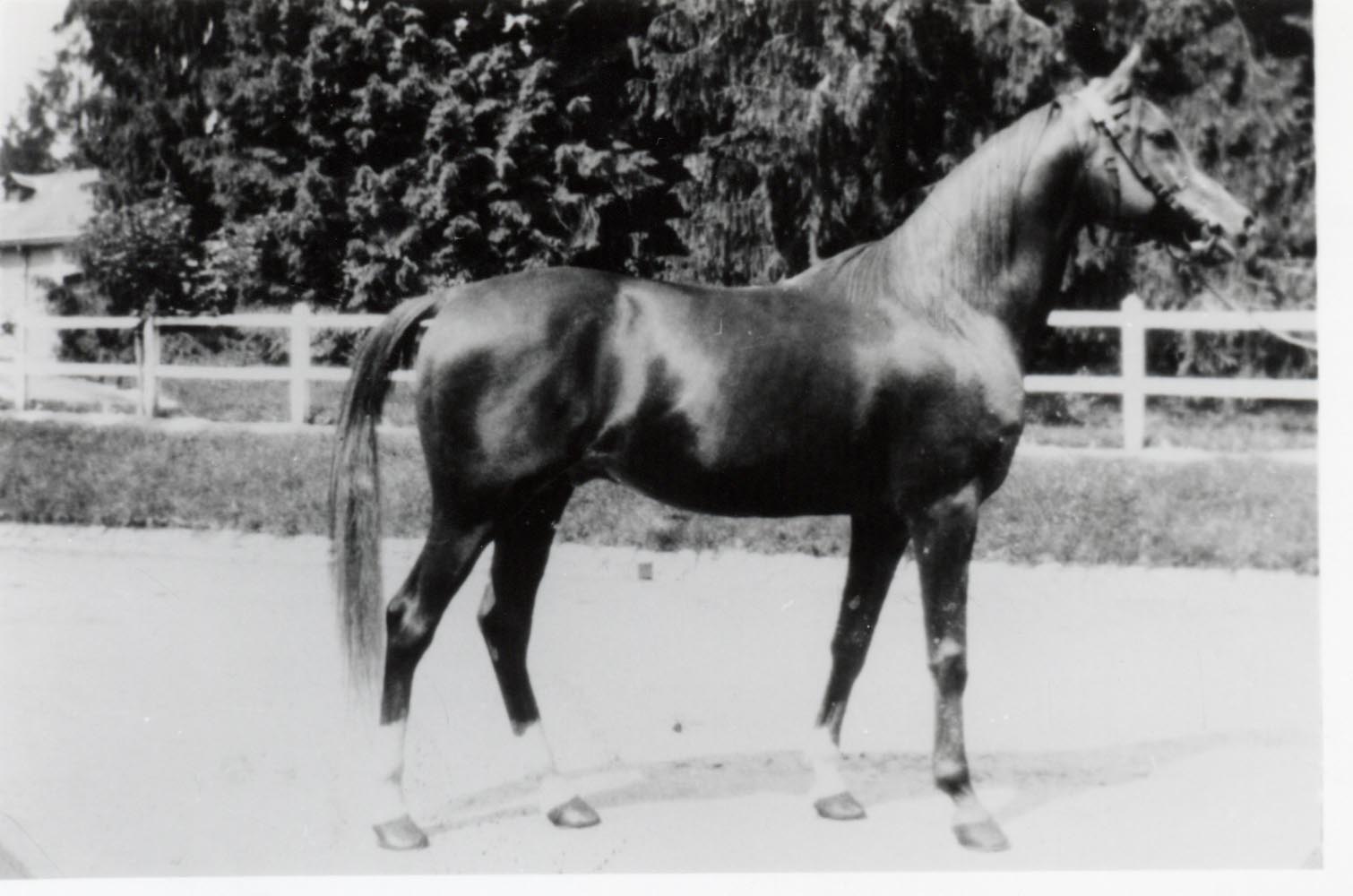
Two Asil lines to El Sbaa survived well into the 1970s: one old French dam-line at Pompadour, and another Algerian dam-line with the French breeder Robert Mauvy.
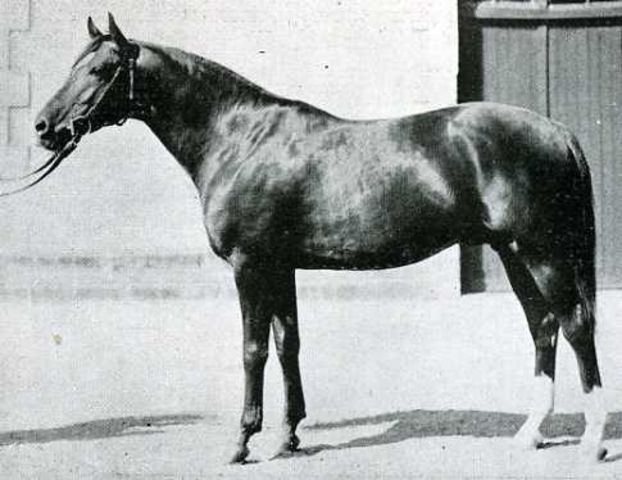
At Pompadour, the last Asil to carry a line to El Sbaa was the very typey mare Ablette (by Sumeyr out of Attique by Meat), born in 1954. This mare, one of the best ever bred at Pompadour, was from the female line of Zenab, a grey Hamdaniyah bred by the Sba’ah Bedouin tribe and imported to France in 1880, with seven other mares, and eleven stallions. Ablette, pictured below, is reminiscent of the some of the old American-bred Asil Arabian horses of Davenport bloodlines. Sadly, Ablette was only bred to non-Asil horses, even though Pompadour did maintain a couple of Tunisian Asil stallions at the time.
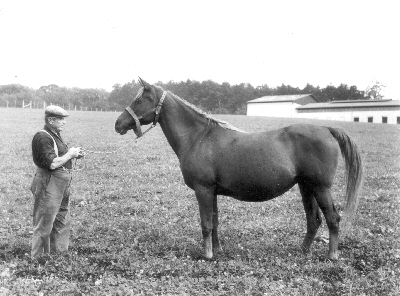
Robert Mauvy kept a small collection of some of the purest bloodlines in France in his estate in Central France. His pride was the chestnut mare Zarifa (by Matuvu out of the Algerian Asil Iaqouta), born in 1946, and her full sister Aouda El Habiba, born 1941. They were from the female line of Cherifa, a bay Shuwaymah Sabbahiyah also bred by the Sba’ah Bedouin tribe born in 1869, and imported by the French to Algeria. Aouda El Habiba had a few Asil offspring which did not breed on, and Zarifa had offspring whose Asil status is pending (in my opinion), and subject to further research. More on this reseach later.
El Sbaa was bought from the stablse of Mr Ibisch in Cairo not from the desert.
De Madron saw him in Egypt while he was on the racetrack and when asked for his owner, he was told that the horse belongs to a wealthy Syrian of Kurdish origins, Mr Ibisch (whose name appears many times in the Raswan Index). De Madron was also told that Ibisch wont sell the horse for any price.
While in Beirut, De Madron met with Mr. Beyhum, an important and wealthy figure in the Beirut society, from whom he De Madron had bought a Hamdani horse who had won many races in Egypt. Beyhum was a good friend of Ibisch, so De Madron asked him to interfere in order to let Ibisch to sell El Sbaa.
Ibisch sold the horse saying ”The Syrian Goverment should never let this horse go away”. In the book by De Madron there is a magnificent picture of El Sbaa’ at the race track in Cairo.
Joe, thank you for the correction about the place where De Madron bought El Sbaa. I don’t have his book, and was referring to Mauvy’s “Le Cheval Arabe”.
The connection with Ahmad Ibish is fascinating, in part because Ibish appears as the owner of the stallion Aiglon, who is the maternal grandsire of the hugely influential stallion Sirecho in the USA.
Hello Edouard,
Thank you for your consideration to the fascinating French Arabian horse history. Let me know if I can help in anyway with researchs on El Sbaa’s progeny in France. It would be so fantastic to find some of his Asils descendants still today! Robert Mauvy has inspired generations of breeders here in France and his book about the “Cheval Arabe” as we proudly call them here in our country is a bible to any french breeder.
Friendly,
Amélie
Hi Amelie, good to hear from you. How’s France treating you? I miss it..
If Denouste’s Asil status was proven beyond doubt(and that’s a far cry), then several horses with a line to El Sbaa would be eligible for Asil status.
Mauvy’s Asil mare Zarifa had several offspring from the stallion Saadi (Ourour x Oureah), and from Saadi’s son Amri, both of whom have a line to Denouste
Mauvy did these breedings, but it’s not enough to prove that Denouste was okay, even if we can assume that Mauvy knew what he doing..
What an interesting thread on French Arabian breeding. Edouard, what is the present status of Robert Mauvy and or his breeding program? Reading some of this thread makes me wonder if you or Joe Achcar, or anyone could shed any light on the French mare *KOLA AHR#485 a 1912 chestnut mare imported to the U.S. in 1922 by W. R. Brown. Her sire is Latif, 1903 bay D.B., and her dam is Destinee, 1893 grey by Maksoude out of Degourdie. She left a 1917 chestnut son in France named Petard, sired by Djebel (Sinai x Dragonne). *Kola was 10 years old when she came here and produced 10 foals so her blood is well circulated in America. Years ago there was an Al Khamsa breeder out west who had some horses that were all Al Khamsa plus *Kola but I do not know if that has carried forward until now. Just wondering what is known about *Kola. Thanks.
Hi Joe, and thanks for your encouraging words. I am passionate about Asil Arabians of French and North African lines. They form a tiny subset of the larger so-called “Arabians” of French bloodlines.
I would love to see the horses from this subset recognized for what they are: Asil Arabians tracing in all their lines to high-quality desert horses. Hence my starting the discussion with presenting some of the desert-bred imports, such as Dahman, Bango, and now El Sbaa.
I will then move to discuss the purity issue.
Joe, I also received your email about *Kola, and I have to think hard about how to answer it. I will definitely get back to you, perhaps on this blog.
Joe, Mauvy died in
1979. [Correction: in 1985] His breeding program was taken over by a few of his disciples. Towards the end of his life, he heavily used the stallion Saadi (Ourour x Oureah), which carries a line to Denouste (Latif x Djaima). I am not currently in a position to assess the Asil status of Denouste. This needs more research. When it is done, then yes, I believe a couple dozen horses of the remnants of the Mauvy program would be eligible.The problem with Denouste, as with other French Arabian horses bred in private farms (except Mauvy’s) is that you have no way of trusting the breeder. This is why most of the horses I talk about in this blog are from Pompadour (a Government stud, with no reason to cheat about bloodlines) or Mayvy (a purist).
Where is exactly the place where grow El Sbaa?
Hi Edouard and thanks again for this wonderful input,
El Sbaa is magnificient.
I wish we have people like you in France and previously Mr Mauvy to educate us about this part of the Arabian history that has been lost in memories and cannot survived if we are not aware of what is remaining?
Hope we will find quickly some asil horses tracing back to the old Pompadour program…
Hey, that’s interesting information on Ibisch. I have already found “Aiglon” in the pedigrees of Tunesian and Morroccan lines – I sent the information to both Hansi and Rogoski together with info on the big trade of desert stock with the French on the Cairo racetrack for their Magreb studs but they found it not worthwhile to pursue or look in that direction. Too bad
The Moroccan Aiglon is not the Aiglon sire of Exochorda. The Moroccan Aiglon is a French racehorse, by Othello III Kasbah II.
Ibisch sold the horse saying ”The Syrian Goverment should never let this horse go away”
And he was right. Why was he not sent back at the first hint of asthma? What, in the end, does it mean when we say we “love” our horses?
Dear Edouard
I wonder if you have any data on “ADJALI” C.1850. I have no sire or dam on him.
He is the sire of AISSA (1870)
FRBS VII/P800 a mare out of Fatouma (c.1860) FRBS XII/P881 bred by Dupont. I show Aissa imported from Algier to France in 1873, etc.
As far as Denauste is concerned, I found nothing which would make this stallion ASIL, although a number of Asils are in his pedigree.
Of course he is in the pedigree of the incredible Manganate.
I have the French Stud book copies I-XIX, and with it a zilians of questions.
Take good care and hugs
Hansi
sorry that should,read stud book copies I-XXIX
Hansi
Hi dear, happy new year to you. How have you been since your heart problems?
Adjali… yes. He is one of the question marks in the pedigree of Denouste.. All I know is from Nicole de Blomac’s book p.267 which says is that the French authorities ‘forgot’ to register him in their studbook.
She explains that omission by writing that when Adjali’s only registered daughter Aissa was born in Algeria around 1870, the French who were colonizing Algeria had not yet began to register the Arabians they had in this country. The French only began to register Arabians in Algeria and Tunisia about six or seven years later.
All we know about Adjali is that he was in Algeria, that the French priest Abbe Houneau used him on his mare Fatouma, and that’s it.
It’s not much.
On the other hand, Robert Mauvy, who was by far French and North Africa’s greatest Arabian horse expert (like Raswan in the USA, but better), thought Denouste was of pure Arab bloodlines, and did use some of Denouste’s descendents. I don’t know what to think.
The problem of Manganate is different. Manganate’s real pedigree is not the pedigree you see in the studbook’s. Manganate is an Anglo-Arab with a fake Arab pedigree..
Hi,
Found your blog by searching on Denouste… Do not forget that the famous endurance Persik stallion has his sire line tracing to Denouste, as well as his mother line.
Concerning Manganate, what are the evidence behind him being an anglo-arab?
Best,
Leonard
a question to all of you here in the forum.
this stallion El Sba’a,the same specified as the father of El Gada’a??? or someone else?
Thanky for any answer’s.
Best wishes:Teymur B
El Sbaa : what do you find in this horse except for a nice head and neck. Can anybody see the weak, inexistant hocks ? The long pasterns and cannons ? The flat underrun feet (except for the right front maybe)? Nowadays a horse like him would probably never be used for breeding performance horses.
On a group on facebook, there has been a discussion of the identity of two photos of El Sbaa which look quite different, particularly in the head. The location of one of them is from the pre-WWII issues of Jezdziec Hodowca, or Rider and Breeder, which was printed in Poland. There was a photo of El Sbaa which was of a quite plain horse with a blaze on the face. Other discrepancies include leg markings, length of hip, legs, etc., can be seen but perhaps the foibles of photography have to be taken into account. I posted both photos of the horse including the one which you have used in your interesting commentary above. I can send the other photo of El Sbaa to you if you wish. If you could give some comments on this issue it would be most appreciated. Thank you very much.
Is the other photo one where he is ridden by a jockey in Egypt?
I have a stallion EL SBAA IV 29 I want info about this line please….
Here my wattsap
+995 511 49 84 41
Ari Veronica
can you share his pedigree Veronica?